BEFORE
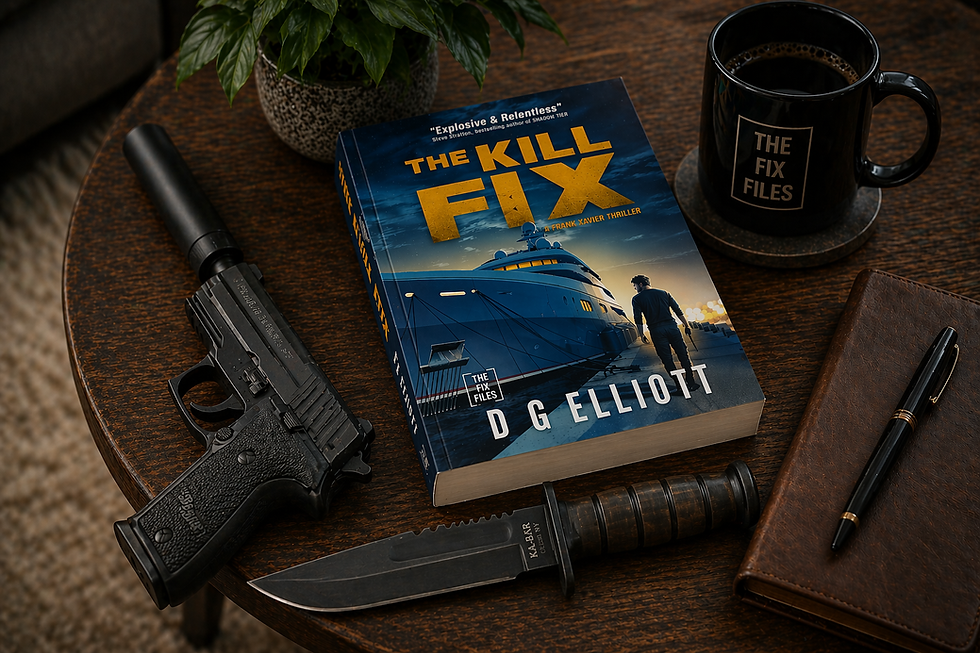
THE KILL FIX,
A TRANSMISSION WAS RECEIVED:
>> CLEARANCE VERIFIED
>> ACCESS GRANTED
SCIF TERMINAL // LANGLEY NODE
SUBJ: TBILISI TRANSMISSION

FILE: //LANGLEY/SCIF-02/FX-001P
PROTOCOL: Classified / SCIF ONLY
OPERATION: TESSERACT
TRANSMISSION: 12 OCT 2023
SOURCE: ANSON, RICHARD/RICK
CODENAME: "ANTS"
{SYSMSG: Voiceprint Confirmed}
MSG ORIGIN: TBILISI
COMSEC: WARNING_UNSECURED LINE
OPERATIONAL REPORT FOLLOWS:
Jack Squat. After four days, that’s all he had. Rick Anson lowered his field optics and rubbed the bridge of his nose, blinking to refocus as he glanced at his watch. It was still too early in DC for the Assistant Director to be in his office, so any decision to abort this dead end would have to wait.
While their predictive model had identified a high-probability threat, it neglected to predict any details they could act on, so the Agency gave him a target and sent him into Tbilisi. After watching that target do absolutely nothing for the better part of a week, Anson still had no answers.
Hell, I’m not even sure we’re asking the right questions.
He’d used an ESN scanner to triangulate the location of a burner phone—one that had recently made calls to a reclusive imam with a penchant for recruiting martyrs. The owner of that phone was a low-level Chechen who went by the name Vascha. Anson’s orders had been to observe Vascha and assemble a profile. But so far, that profile was a blank page. No job. No routine. No contacts. And no obvious purpose.
A giant waste of time—the one thing the new model says we don’t have.
Movement caught his eye, so he grabbed the optics and peered through the lens. The door to the small house where the target had been holed up swung open. Vascha stepped out, and for some reason, he was in a hurry.
Anson followed him into the transportation district—a confluence of warehouses, trucking routes, and railroads. The neighborhood was sparsely populated and had little foot traffic, which made tailing him a challenge. Anson stayed well back, using the phone’s signal to fill in any gaps in surveillance. But after walking around the same block twice, that signal stopped moving. Anson closed in and regained a visual.
From a few hundred feet down the street, he saw Vascha open the door to an apartment building and disappear inside. The property had three stories, maybe a dozen units. Once respectable, now collapsing under neglect. The kind of place no one paid attention to—and no one asked questions about.
Anson found a spot behind some trash bins in an alley across the street. He waited and watched.
Moments later, he spotted movement behind drawn curtains on the second floor. Shadows shifting in low light. Three; maybe four men. One of them still wearing a winter coat.
In the adjacent unit, lights began to go dark one by one. A few moments later, a woman exited the building—elderly, slow, alone.
Sitting out here isn’t going to confirm if this threat is real or not.
He gave it another beat, then moved. Staying in the shadows, he approached the building from the side and peered through the window into the entryway—empty and silent.
When he opened the door, the smell hit him first. Stale food. Cigarette smoke. Rot. Too many people crammed into too little space. The lobby was dim, one working light buzzing overhead. An old desk sat abandoned in the center; a relic from when the building had meant something.
He checked the stairwell—clear—and moved up silently. At the landing on the second level, two doors faced the stairs instead of each other, with a shared wall in between.
Perfect.
The lock on the door to the old lady’s apartment gave easily.
He found himself inside a small and humble home, stuffed to the walls with old furniture, faded photos, and anything that could possibly be knitted by hand. Rusty security bars covered the windows. From the looks of it, she lived alone.
Anson identified the shared wall. Voices bled through—low, controlled, speaking in Russian.
He grabbed a magazine from a table, rolled it, pressed it lightly to the surface, and listened.
Fragments at first. Words he recognized, but pieces that didn’t fit. One word that he obviously translated wrong.
Then it clicked.
The gaps in their intel began to fill. The picture solidified.
What? The threat model didn’t predict anything like this.
He exhaled through pursed lips until the sum of what he knew froze the air in his lungs.
People are going to die. And Washington will have no idea why.
It wasn’t jihad. Or retaliation for decades of regime change. This was death dealt for a completely different purpose.
Everything the CIA knew about the attack was based on a false assumption.
One that would start a war.
He needed to call it in—but not here. If he could hear them, they could hear him. English overheard through these walls would leave him trapped with only one exit. Texting on a state-run cell tower wasn’t secure and left a permanent record. And the encrypted message app on his Agency phone needed a clear line to the sky.
He had two options—wait, or move.
I’m done waiting.
Anson cracked open the door and immediately regretted it—no view of the adjacent flat. The stairwell was less than a dozen feet away, so he stepped into the hallway and pulled the old lady’s door closed behind him.
The man standing at the entrance to the apartment next door eyed him only for a moment before pounding on the door and yelling something in Russian.
Anson bolted for the stairs, taking the first flight in a leap. He almost made it.
A hand caught his ankle. Anson’s trajectory was now hopeless. The landing came fast and went wrong. His torso slammed into the rail. Pain exploded through his ribs as he slid down the handrail into the tapered ornamental endpiece. The point punched through fabric and into flesh, catching under his armpit and pinning him in place. His arm went instantly numb; lifeless.
The man at the top of the stairwell reappeared, drawing a weapon.
Anson ducked the first shot and slid out of his jacket, diving around the other side of the center wall as more rounds burrowed into the plaster where his head had been.
His phone; his weapon—both inside a jacket caught on a rusty handrail in clear shot of a man with a gun.
Adrenaline surged through him. He made it down the last half flight of stairs and out the front door into the cold night air. The pain in his armpit flared—but it didn’t slow him. Not yet.
He remembered that the closest exit route with cover was to his left. No windows from the target’s apartment on that side. An empty lot, then a fence.
With one good arm, he vaulted it and ran.
Good going, Ants. No phone. No weapon. No backup.
And no way to warn the Agency.
He put distance between himself and the apartment building, weaving through warehouses, over rail lines, into the outer streets. The wind whipped around him, its roar peeled off the rush of body heat and soaked into his limbs. A sharp jab knifed under his weakened arm with each cadence of his run. He felt a warm trickle down the inside of his sweater.
Sodium lights flickered on, stealing the shadows he needed. Each breath in the cold air hung behind him—a glowing trail marking his path through the crumbling streets.
When he slowed to blend in, he already knew. They were there, a half a block behind him, on the other side of the street. Matching his pace without looking like they were.
Using the mirror of a parked vehicle, Anson assessed his pursuers. Vascha had crossed the street and was trying to close the gap; the man from the doorway was still on the other side, but now he was on his phone. They weren't openly carrying weapons, so they must not want to draw attention, but a phone call and lack of urgency meant that reinforcements were on the way.
After a glance at his watch, Anson picked up his pace, just enough to look natural—a man late for something on a cold windy night. He rolled the cuff of his sweater tight to keep the blood dripping down his arm from leaving a trail.
No reason to make it any easier for them.
He turned right at the next intersection and jogged for half a block, knowing he’d be momentarily out of their view. Every step and every second between them was precious.
What looked like a tea room appeared ahead on his side of the street. It had a decent crowd, and the single pane windows were steamed up due to the cold outside and warmth inside. It would be hard to see inside.
Slipping in the door, he forced himself not to glance over to see if his pursuers had spotted him. Even a half turn of someone’s head would draw attention when someone was scanning a new field of view.
He surveyed the inside of the tea room. It had a long counter where an old man took orders, with a younger man pouring tea into cups and placing freshly baked churchkela and tklapi pastries onto saucers.
Anson quickly identified his next target. A college-aged girl sat at a table, across from the counter, textbooks and notepads spread open. An older phone sat next to them. Hopefully, it was unlocked.
He walked up to the counter, ordered a black tea and spoke the Russian word for bathroom.
“Vannaya?” he asked.
The older man pointed toward the back and barked the order at the young man.
Anson backed up and brushed a stack of napkins off the counter. When he bent over to pick them up, he placed his hand on the student's table as if he needed support. The textbooks flipped and fell.
He apologized in Russian and began to help pick them up. She also bent over to do so, and while her head was below the height of the table, he placed a book on top of the phone and palmed it with his left hand. He then turned and put the napkins back onto the counter, apologized again, and made towards the back of the room.
Four seconds, maybe five. No one noticed.
The warm trickle under his arm began to gush. He clenched it to his side.
On second thought, skip the tea. Can I order a Makarov and a tourniquet?
Skipping the bathroom, he walked toward the back door, and stepped into the alley. He scanned the field of view and crunched through the snow to the shadows next door.
Turning his back so that the light of the phone would be shielded, he flipped open the old school phone with one hand—the only one that worked.
Unlocked.
Anson dialed a number that he had memorized on the flight into Tbilisi.
The line clicked. Routed. Connected. Clicked again. After an agonizing wait, he heard a woman on the other line.
“Key in?” the voice said.
“Tango Bravo 15972. Op name Tesseract.”
A few more moments passed, only the wind responded as he warily looked around.
“ID Confirmed. Recontact from a secure—”
“Negative. No time. Phone is compromised. I have urgent intel.”
Another pause.
No urgency from the other side of the world. Lives are at stake.
“I’ll transfer you. One moment,” she said.
“I don’t have one! Can you activate record and transcribe?”
Keys clicking. It would send the message to his controller without waiting to connect, and take the operator off the call to maintain OPSEC.
“Ok, go ahead,” the voice said, then heard her mic disconnect.
“SIGINT confirmed, but our assumptions were all wrong. Attack still planned late October as in the intercept, but it’s not what we thought. Acquired HUMINT via overheard conversation. Target Vascha was observed at a meeting with three other individuals, IDs unknown. But they—"
He felt a sharp pain in his spine and heard a thwap sound from behind him. He looked down and saw his legs involuntarily buckle. His brain told him he was still standing.
Anson fell forward onto the ground. The phone landed on the pavement just beyond his reach. He winced in agony and tried to breathe, and he felt himself begin to blackout.
He clawed at the broken pavement, his fingers struggling to find purchase. Using his elbows, he heaved forward and got two fingers on the phone, pulling it toward his head.
“It’s not what we thought,” he coughed.
“It’s just a lone—”
The pain stopped.
>> MESSAGE TRUNCATED <<
NO FURTHER COMMUNICATION RECEIVED...
INTEL ASSESSMENT: ██████ ██ █ ███ ██
PORTIONS REDACTED BY ORDER OF DNI
INSUFFICIENT DETAIL FROM SOURCE...
MOSAIC THREAT ANALYSIS MODEL: INCOMPLETE_
ANALYST NOTE: Initial assessment indicates a divergence between predictive model outputs and field-acquired HUMINT. Further investigation recommended.
—CIA/CTC
CONTINUATION FILE AVAILABLE: THE KILL FIX_mission.1
ACCESS LEVEL REQUIRED.